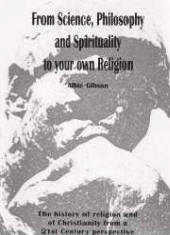
From Science, Philosophy and Spirituality to your Own
Religion - (Albie Gibson - CTS Publishers, Bloemfontein 2003)
The importance of the influence of some ancient religious
and philosophical traditions on the formation of dogma in
early Christianity is often understated. When reading the
Bible in an independent way, i.e., not through the lenses of
any official church dogma, one is amazed by the many voices
that come through to us. Add to this variety the literary
finds from Nag Hammadi, as well as the Dead Sea Scrolls,
then the question now confronting many spiritual pilgrims
is, how did it come about that these obviously diverse
theologies, represented in the so called Old and New
Testaments, were moulded into only one “orthodox” result. In
what way and to what degree were the many Christian groups
different and distinctive form one another, as well as from
Jewish groups? Furthermore, what was the influence of other
religions, Hinduism, Buddhism, Zorastriasm, Judaism, the
Mysteries, Gnostics and the Philosophers on the development
of Christianity? The obvious abundance of groups and their
rich variety is now well known and accepted. Why were we
told there was only one “orthodox” religion from Adam to
Jesus?
Every individual will, to a certain extent, have to make
sense of his life, the world and his own inborn spiritual
inclinations in order to experience his existence as
meaningful. To give meaning to life is therefore an ageless
and universal human quest. Life develops from a struggle for
survival, is followed by our efforts to understand reality
and then to find our place and tasks in the cosmos,
culminating in a personal and perhaps shared, meaningful
philosophical and spiritual answers. Alternatively, many
want life to culminate in a perceived condition called
“salvation”, which can be a belief that you have eternal
life or an experience that can be described as “the peace
that passeth understanding” (Phil.4:7: 7) which, in both
cases, leads to a lack of fear of death. The first option is
a passive religious and mostly “second hand” belief, while
Salvation, as personal peace and experiencing life as
meaningful, can therefore be described as the more mature,
ultimate goal in the process of human striving and
development.
Click here for a complete index of the book.
|
 |
 life skills resources